
Seeing Time
The desire for new aesthetics

Society has processes running in the background, modes of thinking we reinforce to try to keep it all going. At certain moments in history, it’s useful to peer into the event logs.
One societal process revolves around normalizing existence. I mean the sheer fact that we think we exist at all. How we exist. That we can feel relatively assured we live on “the ground,” on “a planet” no less, in a vast, expanding “universe,” made of “cells,” full of dreams. That many of us accept that these terms carry enough explanatory power to keep down the awe, terror, and beauty of existence every day is a miracle.
We invest a tremendous amount of human psychological energy in this normalization. Given our usual tunnel vision, how could we go about our day otherwise? From cosmographical creation stories to simple sidewalks, societal norms allow us to glimpse the magic outside of narratively-scoped existence in doses we can mostly handle.
But when the story feels unstable, an aesthetic opening occurs. Narratively-scoped existence appears more pliable. This can be for better or worse.
You can sense this in contemporary culture as a desire for aesthetic answers to the present. It rumbles, sometimes rings frenetically, but it doesn’t always land.
Return
Often held up as the previous aesthetic engineers of the future, Bauhaus spanned the Interwar Period in its first incarnation as an institution.
After the First World War, Germany faced extreme material shortages, and by 1923, its currency was nearly worthless. The Bauhaus practitioners were working in this context. They could not import high-quality materials like timber, relying instead on materials like “slag concrete,” blocks made from the waste products of nearby coal plants. Like other practitioners of the period, their replicable housing designs came from thoughtful engineering shaped, in part, by necessity.
When Nazi Germany closed down the art school in 1933, its participants dispersed globally. Several of them became cornerstones of American design institutions, with Walter Gropius leading architecture at the Harvard Graduate School of Design, László Moholy-Nagy founding the New Bauhaus in Chicago, and Anni and Josef Albers moving to a quiet town in North Carolina for the newly founded Black Mountain College.
Their widespread influence could make it easy to overlook how much of their work derived from their time. I tend to believe you can’t recreate the influence of Bauhaus by aiming to recreate Bauhaus. Influential networks are always unique, prismatic reflections of historical conditions, even if they espouse timelessness. You can learn deeply from their memory, but it’s challenging to create solely through invoking it.
This is why many calls to return to classical aesthetics miss the mark. They sublimate their own unique historical conditions in favor of transposing an imagined past. This way, the impersonal genius of a particular moment, the genius of a place can’t unfold, but neither can the elaboration of a living tradition.
Instead, the “new aesthetics” you’re looking for require the ability to perceive, to experience, the present.
Perceiving Memory
One way to explore this aesthetic desire comes from the educator John Dewey. He believed art instruction should first teach the student to see, influencing Black Mountain College pedagogy.
For Dewey, aesthetics referred to the quality of any experience attended to fully in all aspects of life, rather than only what happens in an art institution.
In his book Art as Experience, Dewey draws a distinction between recognition and perception. You see someone approaching from far away. Your first response is practical, almost mechanical. You identify them in order to know whether to say hello or, maybe, you’re on bad terms, so you decide to cross to the other side of the street. Recognition, by sorting what’s novel into what’s already known, classifies the other person swiftly enough to act.
But it might not be until some other moment, numinous or arbitrary, that you ever really see them, like a small scar on their left hand or a type of smile that involves their whole face. This is perception, an experience bypassing categorization.
As Dewey writes, “In recognition we fall back, as upon a stereotype, upon some previously formed scheme... We realize that we never knew the person before; we had not seen him in any pregnant sense. We now begin to study and to ‘take in.’ Perception replaces bare recognition. There is an act of reconstructive doing, and consciousness becomes fresh and alive.”
At first, it’s a practice that reconstructs perception. Then, at times, it can precede recognition entirely.
Dewey adds, “Everyone knows that it requires apprenticeship to see through a microscope or telescope, and to see a landscape as the geologist sees it.” So why not the practice of perception?
I started writing this essay while in London, walking the same route every day through the Barbican past St. Giles church. It spans two thousand years of layered construction: Roman wall, medieval church, brutalist tower, glass office block. Each material points to its era. The accumulated memory of these layers gives the walk its depth in time, but if I don’t really look, it can flatten into recognition. I roughly see old stones, medieval crests, some replicas of each, modern offices, and move on, without perceiving the particular angle of light across them, the historical conditions that stood them next to each other, now. In other cities, this enormity appears even deeper. Even in places without much recognizable artifice, we can perceive the enormity of conditions that led to this layer of rock, this bending tree, at this moment. Rather than immediately seeing categories in the environment, a quality of transformation appears.
Seen this way, the desire for new aesthetics tends to recognize the desire for something novel before it can perceive the novel in the present.
But emphasizing perception over recognition doesn’t imply ignoring tradition. Memory is always waiting. As Dewey notes, a child’s second encounter with fire carries a different quality than the first.
The experience that transforms into art, that is art, involves that instant between perception and recognition in which we might begin to see time itself. Memory is a kind of transformative medium between the two. It’s Dewey’s “reconstructive doing.”
Philosopher Simone Weil saw time in this way, especially in her work on the epic poem The Iliad. While thousands of commentary pages exist on the poem, she newly inhabited it through The Poem of Force.
She wrote that the subject of The Iliad is force, force defined as that which turns people into things. Force doesn’t abide with victors in a battle, instead “in this poem, there is not a single man who does not at one time or another have to bow his neck to force.” The poem mainly adorns those who wield force with arbitrariness, then at times, tenderness.
She claims The Iliad is unique in the European tradition for this, even among the epic poems that followed it. As the last lines in her work assert, its genius can only return when we “learn that there is no refuge from fate, learn not to admire force, not to hate the enemy, nor to scorn the unfortunate.”
Amidst the memory of one war and the premonition of another, she wrote this text in 1939 Europe, opening it with skepticism of those who believe society left force behind in antiquity. In the poem, she had already encountered force fully. Meeting it again in her own present, like the child’s second encounter with fire, she could perceive it beneath the usual familiarity. Her present turned “fresh and alive,” if nearly unbearable.
Paradoxically, the new can come through a lineage of work. It depends on the nuance of transmission more than its invocation. Connection to a tradition knows what came before it so wholly it can create through it.1
If novelty can emerge at all, this is often how it does, upon the layers of rock, through transformed memory.
Perception Now
We’ve learned to crave feeds that impose a steady stream of unconscious, dreamlike images we struggle to forget, but also to fully remember. In the millisecond interval during which we might practice perception, a “reconstructive doing,” another image already enters into our view. The patterns of digital media extinguish this interval, though they don’t make it impossible.
Once Terence McKenna suggested the most sought-after drug we could invent would be one that allows us to remember all of our dreams. We may have built something close, except the dreams aren’t ours, and we can’t quite wake up from them.
But the only way out, as McKenna might say, might be through.
Some of these digital media images we recognize immediately, and some of them don’t resolve into something familiar. I’m reminded of an image I first saw on the internet with the caption: “Name one thing in this photo.” As you scan the objects in the picture, you realize what you might have recognized as a dresser is, in fact, not a dresser, and the objects on it are not really objects, more like mildly discontinuous blurs. The visual patterns only approximate familiar things.
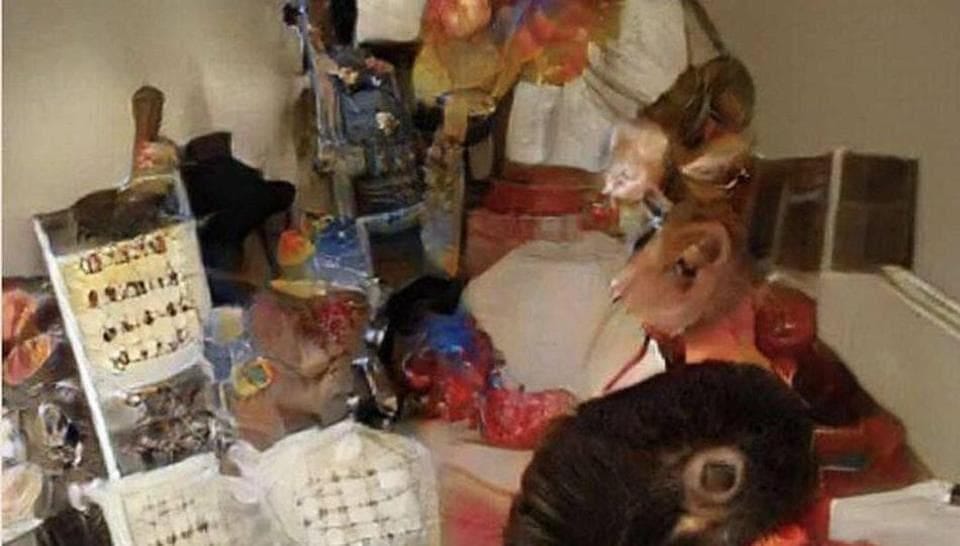
The discussion around the image claimed it was generated by AI. Then another story began to travel. A post claimed researchers had produced the image to simulate a serious medical condition in which the brain can no longer match visual input to stored categories.
Months later, thinking of it, I looked up the source. The post author admitted they had invented the medical explanation. The image most likely came from an early neural network, but an unrecognizable image doesn’t transmit without a story for long. The story explained the feeling.
The idea that an image is unrecognizable because it has been generated by AI seemed intuitive to me at the time, though that hasn’t been what’s happened since. Images we produce with generative AI usually depict highly recognizable, albeit surreal, scenes. They prioritize recognition over strange valleys of the almost-known.
The discussion around generative AI images claims we’re facing a crisis, that soon we’ll no longer be able to trust images to portray reality, but we’ve misunderstood our own position in this historical anomaly.
We’ve been living in the brief period during which we expect images to provide authentication. Authentication, as we understand it now, has almost always come from a specialist, like the manuscript of a scribe, the paraphernalia of a miracle, or the stamp of a notary. A version of that specialist role will persist through technical regimes built for authentication.2 At times, though, we’ll again be adrift in a world of symbols, left to feel the future like those before us, clinging to our preferred authenticator. Maybe we’ll explore our experience more. (I’ll write more on this soon.)
The jarring part is primarily the expectation that images portray reality in a straightforward way. Our current, inherited frameworks for normalizing existence are running into conditions they weren’t built for. The unrecognizable image points toward this, something closer to the actual feeling of the future.
What happens if we loosen our expectations?
Feeling the Future
Usually, to preserve expectations, we give our everyday energy to normalizing existence.
There is a different way to direct that attention, close to what philosopher Federico Campagna calls prophetic culture, the cultivation of the conditions through which a new world could appear.
As Dewey wrote, “Perception is an act of the going-out of energy in order to receive, not a withholding of energy.” It’s more of a somatic act, at first akin to cupping one’s hands. The more intelligence grows through language, the more we can foreground the subtlety of human sensing. I’ve heard people describe just being on a smartphone as an “out of body experience.”3 That out of body experience, then, is the perception to start from.
If we were to relinquish the impulse to normalize, even slightly, and instead receive, to really feel, the potential unrecognizability of the future, we could be overcome with terror. We could also sense beauty, freedom, or peace. Truly anything. If we don’t allow these sensations, we can’t really see what’s changing.
Narratively-scoped expectations of the future tend to use the past as a fulcrum rather than a transformative medium. Either everything is departing from it in predictable ways, or nothing is changing, only becoming more of what it already was.
Seeing time involves not misrecognizing the future in relation to the past, and it involves, for a moment, not recognizing the present in its usual familiarity.
I’m publishing this now because no narrative about the future feels certain. When the stories destabilize like this, an aesthetic opening occurs. We can start to perceive the enormity of conditions that led to this layer of rock, this bending tree, at this moment. The new aesthetics we create may, in some ways, be very old.
This post marks the beginning of sharing my writing on memory, technology, and culture every few weeks here.
Christopher Alexander wrote in The Timeless Way of Building on transmission: “Every society which has lived for a long time in a place has created a pattern language which fits its culture, climate, materials, and social life. These languages are different from place to place, and none of them can be transferred wholesale to another culture... A pattern language is a living thing. It is never complete, and it is always being modified by the people who use it.”
See, for example, Roc Camera by July Hata.
The first time I heard this was at Reggie James’s talk on new hardware in 2025.
Excellent piece 🙏
Calling all genuine true-blue red-blooded American journalists, writers, authors, artists, musicians, poets, lyricists, & other masters of the pen.
Be brave, take risks, live free, & put it all out there. If you won't give us your lives, give us your souls. America needs a few patriots.
Revolution is the solution.
#writers #artists #musicians #poets